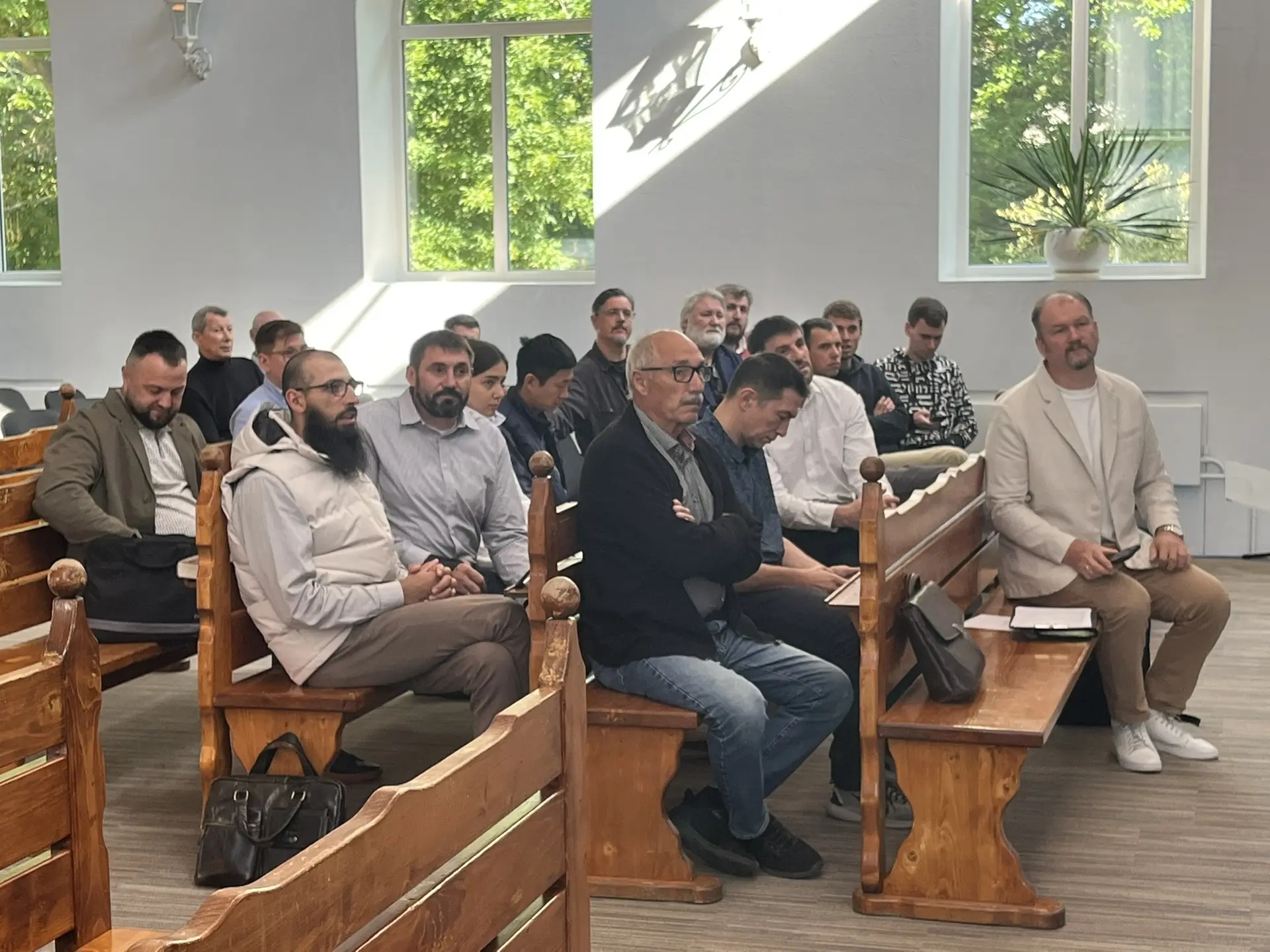
On August 15, 2026, a Moscow regional pastor's conference was held at the UIstra Evangelical Christians-Baptists Church. More than 50 brothers and sisters represented congregations from Krasnogorsk, Nakhabino, Istra, Podolsk, Orekhovo-Zuyevo, Zheleznodorozhny, Balashikha, Naro-Fominsk, Noginsk, Khimki, Ruza, Lukhovitsy, and Solnechnogorsk.


“How beautiful upon the mountains are the feet of him who
brings good tidings, who proclaims peace, bringing good news of joy,
preaching salvation, saying to Zion: “Your God reigns!”
Isaiah 52:7
The meeting was chaired by Alexei Pichugin, First Deputy Chairman of the Russian Union of Evangelical Christians-Baptists, Senior Presbyter of the Union of Churches of Evangelical Christians-Baptists of the Moscow Region, Pastor of the Noginsk Church of Evangelical Christians-Baptists, with the participation of Vitaly Moroz, Head of the Missionary Department of the Russian Union of Evangelical Christians-Baptists, Senior Presbyter of the Volgograd and Astrakhan Regions, Pastor of the Central Church of Evangelical Christians-Baptists of Volgograd.
The central theme of their frank conversation and shared prayer was the vital ministry of every evangelical church: evangelism. The brothers discussed the real challenges they face today, shared specific examples of how various formats for spreading the Good News work, and outlined steps for future collaboration. They also visited the new House of Prayer in Istra. Thanks to the brotherhood’s courage, the building has been under construction for eight years, and by no other means than the power of God. Funds for the construction of the House are coming in spontaneously and constantly, allowing for continued construction and a living testimony of how the Lord fulfills His will.
Currently, there are 40 registered Evangelical Christian-Baptist churches and three home groups in the Moscow region, uniting approximately 2,500 believers. While the churches have many children and teenagers, the tendency is that few dedicate themselves to God, are baptized, and actively serve. This clearly indicates weak mentoring and often poorly planned ministry among teenagers and young adults. Not every church actively promotes the ministry of “fishers of men” for a new life in Christ Jesus.
Vladislav Vovk, First Deputy Rector of the Moscow Theological Seminary and Pastor of the Istra Evangelical Christians-Baptist Church, suggested that “the church sometimes resembles a public service center, where all sorts of issues are resolved. Meanwhile, we forget about missions, about the fact that a Christian is called to be a witness to Jesus Christ. There are several reasons for this: we don’t know the Gospel. And evangelism is a reminder of the four spiritual laws: God loves you, the whole world is sinful, Christ died for our sins, and you will be saved if you believe. The main question is: do you believe that Jesus died for your sins, that He will forgive your sins, and that you will go to heaven?”
Sometimes fear and shame get in the way: in Russia, we are sectarians; we will be misunderstood at work, laughed at in a student group…
Worldly values ensnare us, obscuring what’s most important. Remember, Paul had about eight relatives who were churchgoers. What good is education and success if they don’t lead us to God? Sometimes they say, “Get married and then come to church, otherwise there are no suitors.” We must first pray for repentance, not for healing, if someone is suffering physically. If Jesus isn’t a treasure for you, how will you attract others to Him? We must teach the Gospel, be unafraid, and boldly preach Christian values. It is written: “If then you have been raised with Christ, seek those things which are above, where Christ is, seated at the right hand of God. Set your mind on things above, not on things on the earth” (Colossians 3:1-2).
[08.09.2026 13:29] Jake Schwarze: The brothers noted that there are other reasons why evangelism is “slowing down.” Sometimes it’s simple laziness of soul and spirit, a preoccupation with the church’s internal affairs, or, as they say, “first love” for Christ has passed. Fear of those in power is also strong. But it’s essential to simply master basic legal literacy when evangelizing and remember that personal evangelism is permitted, and a law-abiding evangelist need only carry a minister’s ID and church-stamped literature.
Some noted a lack of communication and accountability to wise mentors, as well as misguided teachings: “God will guide me, I’m just living my life.” Christians often don’t know where to start a conversation or how to interact with people. Christian Schwartz, in his book “Natural Community Growth,” noted that 10% of church members are capable of interacting with strangers, but they need to be identified and trained!
Prayer is the engine of evangelism
How to ignite the fire of evangelism? David Westram, pastor of the Saltykov Church of Evangelical Christians-Baptists in Balashikha, emphasized prayer: ” Prayer and evangelism are directly linked. Prayer is the engine and core of evangelism. The goal of the local church is not to focus on the internal well-being and comfort of life, but to go out into the world.” David also noted that before beginning a “campaign to the worldly people,” it is important to pray properly. “There is no prayer in the New Testament called ‘Bless us, O Lord!’ A conversation with God must be on a specific topic. There are 70 specific prayers of Paul in the New Testament, and over 360 specific prayers in the entire Bible. Holding a prayer meeting impromptu is a grave sin. We must prepare for prayer very seriously. We must decide in advance what we will pray about. And we must remember: boring prayer will die.”
The brothers shared examples of effective evangelism that reaches people’s hearts. Street evangelism: at Easter and Christmas, they organize theatrical performances and celebrations in city squares, distribute bread and candy along with flyers, booklets, and calendars, and sing Christian hymns to the accompaniment of guitar music.
Online evangelism: creating social media pages. It’s also important not to miss anyone who crosses the church’s threshold. In Istra, for example, sisters are assigned to “go after newcomers,” so that each person immediately feels God’s hand through His children. By God’s grace, the director of the technical school in Naro-Fominsk allowed a brother-teacher to perform a Nativity play for the students, and in the fitness club, a T-shirt with the slogan “The Kingdom of Heaven suffers violence” (Matthew 11:12) is a real eye-catcher.
In Ruza, the brothers added a dot with the church’s address on Yandex Maps, and thanks to this, the “Light of the Gospel” church was included in the city’s architectural plan. Now tourists eagerly visit the church to see “all the city’s holy sites.”
Another Russian project: “Echo of Golgotha,” a collection of Christian folk art: poems, short stories, novellas, and songs. Mikhail Kuchukov initiated this initiative. Over the past year and a half, he has received over 60 interesting submissions. By the way, if you have anything to offer Mikhail, please send it to his email address.echogolgofy@gmail.com.
Pastor Mikhail Rumachik of the Istra Church said he organizes a day of good deeds once a week: “I look for people to personally help, physically and spiritually. After such targeted interactions, the Lord changes a person radically.”
[08.09.2026 13:29] Jake Schwarze: They also recalled a unique example of seemingly effortless seasonal evangelism. The Moscow Central Church of Evangelical Christians-Baptists regularly hosts organ concerts and choral singing. Since 1898, a unique organ designed by German master Ernst Revere has been housed in the main hall. With 38 stops, it ranks third in Moscow in terms of number after the organs in the Tchaikovsky Concert Hall and the Great Hall of the Moscow Conservatory. Since the massive doors are usually wide open in the summer, and the Moscow Central Church is located in the very center of the capital, it is a stop on many tourist routes. Guides often take their groups into the beautiful historic building. Thus, seemingly “accidentally,” many tourists encounter Christianity for the first time here.
But not every local church possesses such a versatile arsenal for spreading God’s Word. What must churches do to fruitfully fulfill the Great Commission? Grow spiritually, and spiritual growth is only possible through labor in God’s field. Discover believers with the gift of evangelism and cultivate a prayerful spirit within the church.
Evangelism and mission are the result of a personal relationship with God.
“Mission is one of the best schools for practical evangelism,” emphasized Vitaly Moroz. “In the Volgograd church, at best, half of Sunday school graduates attend the youth group. But 90% of the youth should stay. Sunday school shouldn’t remain a transit zone for teenagers. The whole world is fighting for teenagers, except the church. And trusting in God alone isn’t enough. The most confusing and turbulent age is from 13 to 18. If you want to catch them at the start, start asking them questions; if you don’t, start building rehabilitation centers. But that will be a different network. Teenagers are not objects of ministry, but subjects of ministry. We shouldn’t wait for them, but engage with them. We should go down to the pulpit and have tea with the kids, play football, help them open up and talk about their problems. Our Sunday services are not intended for teenagers; the main work should be done with them on the other days.”
Children’s and youth playgrounds are a type of short-term mission. During week-long missions, a team of ministers provides assistance to elderly people with disabilities and large families, visiting orphanages and homes for the elderly and disabled with concerts and programs. The support of the believers in the host churches is crucial; this encourages and strengthens the local churches. The mission unites traditions and nationalities, and churches begin to grow and think more broadly. It is a spiritual investment that bears tangible fruit. “Mission helps us rediscover the purpose of the Great Commission,” says Mikhail Razvodovsky, coordinator of short-term missions at the Russian Union of Evangelical Christians-Baptists.
A special ministry is in post-war areas. Since March 2022, weekly trips to Donbas and Mariupol have continued. The 214th shift has already concluded. The workers deliver essential supplies: clothing, food, and water. But most importantly, they reveal the love of Christ to people who have experienced terrible tragedy, enriching each other and changing each other’s hearts.
Alla Stambolidi,
Candidate of Historical Sciences, member of the Union of Journalists of Russia.