

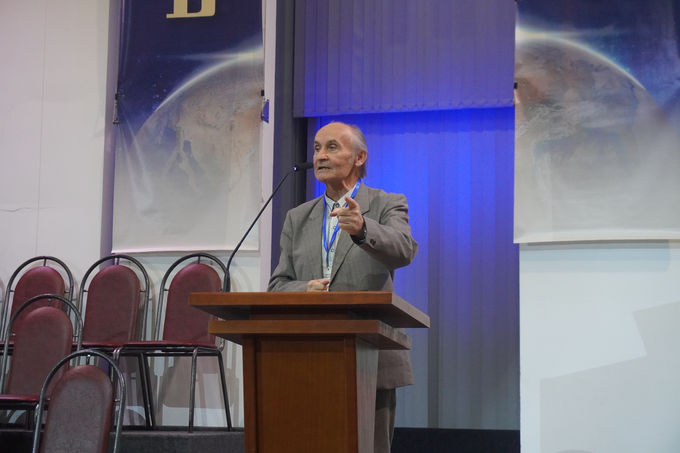
See also: A large photo report on the historical conference
The program was set by a unique musical group – the Moscow Central Baptist church choir, under the direction of Irina Timchenko. The choir performed, with brief comments, chants of Orthodox origin, songs based on folk motifs and spiritual verses, gospel chants, compositions by Dmitry Bortnyansky, Stepan Degtyarev, as well as works by the gospel composer Nikolai Kazakov.
The repertoire selected in this way with a very broad musical palette showed the uniqueness of the musical and singing culture of the Evangelical Baptist movement, the deep content in which the Evangelical faith and the soul of Russia are harmoniously combined.
The Director of the Institute of Sacred Music, Kirill Goncharenko then spoke about the creation of a new musical language that evangelical composers sought to create. Even years of persecution could not suppress the creative process. Secret meetings and seminars of choirmasters and composers were organized. Music ministers wrote petitions to open choirmaster courses and eventually achieved their goal to which the Institute of Sacred Music was subsequently formed and developed, now celebrating its 45th anniversary this year.
Another speaker, Vladimir Stepanov, a historian from St. Petersburg, noted the tradition of striving for a comprehensive education was brought into the Baptist movement by aristocrats who had become believers. Ordinary workers and peasants became good preachers, having been trained at special meetings under the guidance of persons from the educated class.
Mikhail Ivanov (Teacher at Moscow Theological Seminary) gave an extensive analysis of the era when the Union of Baptists was formed. The situation in the country was extremely difficult due to the terror and murders committed by revolutionaries. The authorities were forced to tighten the laws. Baptists as non-Orthodox Christians also experienced strong pressure from the state, clergy and their closest circle. The Union was formed as a church and a community of like-minded Christ-followers. Preaching the Gospel and missionary service were put at the forefront of all the activities of the Union.
At the same time, another branch developed and actively operated as a type of Baptism – the Evangelical Christians-Pashkovites. The core of this branch consisted of representatives of the highest Russian aristocracy: Vasily Pashkov, Modest Korf, Alexey Bobrinsky and high society ladies-aristocrats: Elizaveta Chertkova, Natalya Liven, Vera Gagarina, Yulia Zasetskaya.
Vladimir Popov, a teacher of history and theology at the Institute of Sacred Music, spoke about the specific contribution of the evangelical aristocrats to the history of Russia and their influence on the church and society. Using their connections with the royal family and high-ranking officials, the believing aristocrats were able to develop and implement a grandiose project for the spiritual, evangelical enlightenment of Russia. They founded the Society for the Encouragement of Spiritual and Moral Reading, publishing spiritual literature and evangelical periodicals in huge amounts and distributing them throughout the Russian Empire.
The contributions of St. Petersburg aristocrats in developing the Russian national economy were massive. Vasily Pashkov had 13 estates and 2 copper ore factories. Count Alexey Bobrinsky had brick and sugar factories. A general's wife, Elizaveta Chertkova, Princess Natalya Liven, Princess Vera Gagarina owned multi-industry farms and factories. On their initiative, schools, hospitals, training workshops, and power plants were built. All of these were the fruits of living active faith. Living faith is unthinkable without service to others - and they practically demonstrated this. Because of this, they also entered the Baptist movement, and a merger occurred making one spiritual family, thus the spiritual, intellectual and cultural horizons of the Baptist communities expanded.
In addition to thematic reports and choir performances, the conference program included history knowledge competitions, panel discussions on the historical path of Russian Baptists and also its current standing in Russia.
Among the conference participants were not only from Moscow churches and region, but also believers from Stavropol, Khabarovsk, and the central regions of Russia.
"The conference gave me a lot of information, a lot of food for my mind and heart," commented lead Voronezh pastor Oleg Alekseyev. "We must know how our fathers and grandfathers lived and served the Lord. Without knowing history, we will not be able to preach the Gospel in its entirety, we will not be able to fulfill the Great Commission of Christ. This is the main task of the church, both before and now. I constantly have to communicate with secular people from various institutions, and I see how they need spiritual and historical education for a correct, competent understanding of our churches."
The main organizers of the conference, UECB President and VP, Mitskevich and Ignatenkov, also gave some encouraging words with instruction, they called they called upon everyone to remember the detailed historical path of the brotherhood, to learn from it both the positive and negative lessons, to do the work of an evangelist, relying on the experience of those who have gone before them.
